
 |
Variety Over Restriction: Rethinking Food Sensitivities & Histamine
Food Sensitivity testing is everywhere these days. While it sounds appealing — finally having answers to what’s making you feel off. The truth is, most IgG food sensitivity tests are expensive and don’t tell you much beyond what you already know: what you’re eating most often.
What these tests tend to measure is your IgG response, which is part of your immune memory. If you eat a food regularly, your IgG levels to that food will naturally rise. That doesn’t mean it’s dangerous, or that you’re allergic, it just means your body recognizes it.
It’s very different from a true allergy test (IgE). IgE reactions are immediate, potentially life-threatening, and testing is covered by insurance. IgG tests? Not covered, because they don’t diagnose a true allergy. I don’t often agree with insurance coverage, but do I on this one! If you need clarity on true food allergies, please reach out, we can help order labs for IgE testing.
And remember: an IgE reaction is a medical emergency.
Why Food Rotation Matters More Than Expensive Testing
Here’s an example from my own practice. In my entire career, I’ve ordered a food sensitivity (IgG) test only once. And that was because a patient insisted. Years before, another naturopath had run one of these tests, and it showed soy as a problem for this patient. Why? They were drinking soy milk every day.
So they switched to almond milk. Fast forward a few years: they repeated the test with me. Guess what popped up this time? Almonds.
This is the cycle I worry about: every time the test is repeated, a new food comes up, and patients end up restricting more and more. Pretty soon, their food world shrinks down to almost nothing. That’s no way to live.
Instead, I teach this: rotate your foods, especially by family. If you’re eating broccoli every single day, swap it for another veggie family tomorrow. If oats are your go-to breakfast, alternate with rice or quinoa. It’s not about rigid rules, it’s about variety. Variety broadens nutrition, keeps your immune system calm, and makes food joyful again. And help your gut bacteria get diversified – a true badge of health!
Histamine: Awareness Without Fear
Another layer to food variety is histamine. Some foods naturally contain higher histamine (like spinach, tomatoes, or eggplant). Others act as histamine liberators (like citrus, strawberries, or chocolate). Histamine liberators are foods that naturally do not have high histamine, but have another enzyme that in some people causes the release of histamine from your mast cells, white blood cells involved in our immune system.
This doesn’t mean you should fear these foods or cut them out entirely. It simply means: don’t lean on the same high-histamine or liberator foods every single day.
Rotate. Give your body variety.
Tools For You
To make food rotation simple, I created printable food family charts you can keep on your fridge. They’re not “set in stone” diet rules, but gentle guides to help you expand your options and make food fun again.
Link to PDFs are hyperlinked with each picture:


I can’t resist leaving you with one of my favorite poems mixing botany (plant families) and romance:
Robert Frost on the Rose Family
The rose is a rose,
And was always a rose.
But the theory now goes
That the apple’s a rose,
And the pear is, and so’s
The plum, I suppose.
The dear only knows
What will next prove a rose.
You, of course, are a rose—
But were always a rose.
Just as Frost reminds us that apples, pears, and plums are all part of the rose family, we’re reminded that foods are connected in ways we don’t always see. Understanding those connections helps us rotate wisely, not restrict fearfully.
My philosophy is simple: testing (sensitivities) less, rotating more, and enjoying the variety
If you suspect a true allergy, let’s get you properly tested with IgE antibody. If you’re struggling with sensitivities, histamine overload, or narrowing food choices, let’s work together on a plan that supports your health while keeping food joyful.
Histamine overload
Histamine isn’t only about food — it’s also a neurotransmitter, an excitatory neurotransmitter. That means it can activate your nervous system. When histamine levels rise too high, it may show up as:
- Headaches or migraines
- Racing thoughts, anxiety, or restlessness
- Insomnia or waking frequently at night
- Flushing, itchiness, or hives
- Fast heartbeat or palpitations
- Digestive upset (bloating, loose stools, nausea)
- Feeling “wired but tired”
In other words, histamine overload can make the body feel stuck in overdrive. Learning how to lower the load (by rotating foods, supporting gut health, and stabilizing mast cells) can help reset the balance.
If you suspect histamine overload, whether it shows up as stress, sleep disruption, or food reactions, know that you don’t have to untangle it alone. This is where we can dig deeper together.
If you’re struggling with sensitivities, histamine issues, or narrowing food choices, let’s work on a plan that supports your health while keeping food joyful.
Because life’s too short to be intimidated by your plate!
| Schedule An Appointment |
Fun Activity: How Many Plant Families Are on Your Plate?
Step 1. Print the handouts:
Step 2. At your next meal, take a look at your plate. Count how many different plant families are represented.
Step 3. Write them down (ex: Brassicaceae = broccoli, Poaceae = rice, Fabaceae = black beans, Lauraceae = avocado, Solanaceae = tomatoes).
Step 4. Take a picture of your plate and email it to me along with your list of plant families. I’d love to see how creative and colorful your meals are!
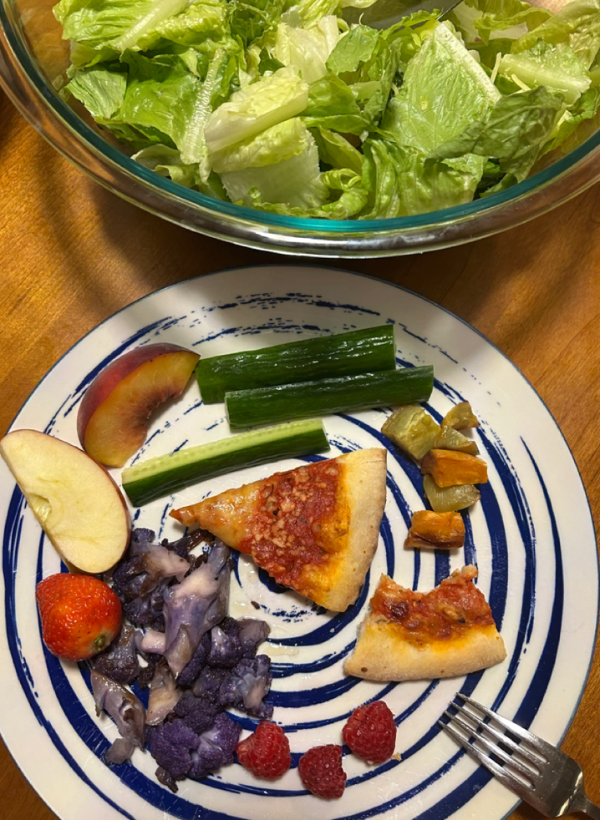
Here’s my plate from yesterday’s dinner. Credit for putting this plate together goes to my 9 year old daughter. She likes me to fix her a “raccoon plate” whenever she starts scavenging for snacks. She made these for everyone in the family for dinner.
- Rosaceae: strawberries, raspberries, apple, peach.
- Brassica: purple cauliflower
- Cucurbits: cucumber
- Poaceae: wheat in the pizza
- Nightshades: tomato sauce in the pizza
- Convolvulaceae (sweet potato family): sweet potatoes and yams
- Daisy family: lettuce
 |
Warmly,
Dr. Jamie Agisheva
Clinic Owner and Director
 |
ISM Health PLLC
18404 102nd Ave NE Suite B
Bothell, WA 98011
ISMhealth.org
(425) 492-0082
You received this email because you signed up on our website or made a purchase from us, or we met in the community.
We enjoy staying in touch in order to share useful information about health-related subjects and to keep you updated on the latest at ISM Health. If you’re not finding these emails enjoyable, you’re welcome to unsubscribe at any time. No hard feelings!
If you are a patient, unsubscribing does not unsubscribe you from receiving appointment notifications and other patient-related communication.